
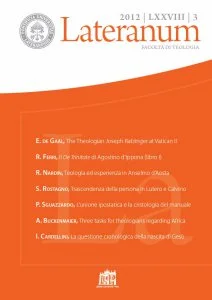
Descrizione
Summary
The first part of this article examines the experiential horizon of communio as the environment in which Anselm of Aosta determined the personal form of his intellectus fidei according to three qualities: an expressive form, an argumentative form, and a theological form. The biographical features of this article demonstrate how these three different features of his intellectus fidei correspond to different existential aspects of his life.
The second part of the article focuses on Anselm’s spiritual experience. However, instead of examining his explicitly “spiritual” writings, themselves the object of various scholarly studies, the article concentrates on treatises, in particular Cur Deus homo. In this treatise Anselm asks what kind of spiritual experience can be reconciled with theological research into the reasons for the incarnation in the absence of any methodological reflection on Christ.
Recensioni
Ancora non ci sono recensioni.